Military orders
The Teutonic Knights
A field hospital beneath the walls of Acre became the German order that conquered Prussia: a black cross on a white mantle, the fortress of Marienburg and the defeat at Grunwald.
In 1190, during the siege of Acre in the Third Crusade, merchants from Bremen and Lübeck set up a field hospital beneath the walls for the German crusaders, using the sails of their ships as tents. From that brotherhood was born, a few years later, the Order of St Mary of the Teutons: in 1198 it was turned into a military order, on the model of the Templars and the Hospitallers, with an additional task, the defence of German-speaking pilgrims.
A black cross on a white field
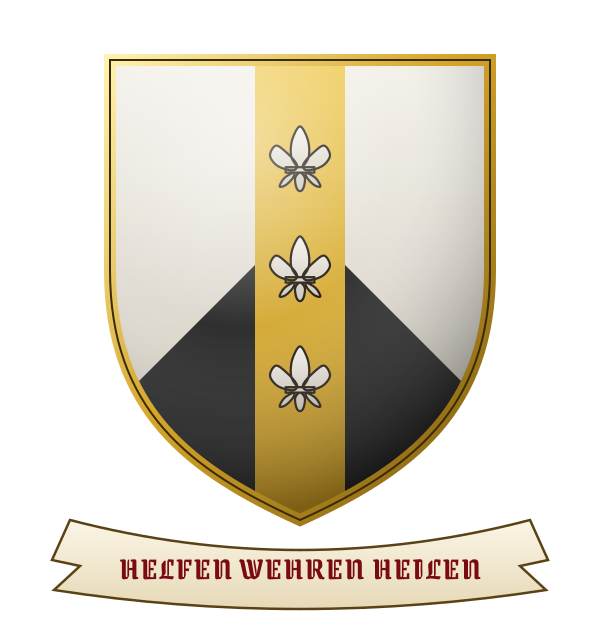
The knights wore a white mantle with a black cross. Their motto, Helfen, Wehren, Heilen, "to help, to defend, to heal", sums up the order's double soul, hospital and military. The Teutonic black cross lies at the origin of symbols that German history would use for centuries, down to the Iron Cross.
Hermann von Salza
The Order's great organiser was Hermann von Salza, Grand Master from 1210 to 1239, a highly skilled diplomat and a friend of Frederick II. He mediated between emperor and pope, accompanied Frederick on the crusade that in 1229 returned Jerusalem to the Christians by negotiation, and won decisive privileges for the Order. With the Golden Bull of Rimini, in 1226, Frederick granted him the lands he would conquer in Prussia.
The Northern Crusade
From 1230 the Teutonic Knights fought the pagan Prussians of the Baltic and built a true monastic state, with towns, castles and trade. In 1309 the Grand Master moved his seat to the fortress of Marienburg, today Malbork in Poland, the largest brick castle in the world. The campaigns against still-pagan Lithuania drew knights from all over Europe.
Grunwald and decline
The conversion of Lithuania and its union with Poland took away the Order's justification. On 15 July 1410, at the battle of Grunwald, or Tannenberg, the Polish-Lithuanian army destroyed the Teutonic one and killed Grand Master Ulrich von Jungingen. In 1525 the last Grand Master in Prussia, Albert of Brandenburg, converted to Lutheranism and turned the Order's territories into a hereditary duchy.
Today
The Teutonic Order survived in Germany and Austria and in 1929 was transformed into a clerical religious order, with no more fighting knights. It has its seat in Vienna and devotes itself to care for the sick and the elderly, returning in this way to the hospital at Acre where it was born. Its history runs parallel to that of the Order of the Temple and of the Hospitallers, the three great orders born of the crusades.
Watch the video
Sources and further reading
- W. Urban, The Teutonic Knights. A Military History (2003)
- U. Arnold (ed.), Die Hochmeister des Deutschen Ordens 1190-2012 (2014)
- Peter of Dusburg, Chronica terre Prussie (1326)
- Frederick II, Golden Bull of Rimini (1226)
- Teutonic Order, official website
Read next
The Knights Hospitaller, from Jerusalem to Malta
Born from a hospital for pilgrims, turned warrior monks and then lords of Rhodes and Malta: the order that inherited the Templars' property and still exists today.
The Holy Grail: birth of a legend
From a mysterious “grail” in a twelfth-century French romance to the cup of the Last Supper: how the most sought-after object in European literature was born and transformed.
Perceval and Parzival: the knight of the question
The naive boy raised in the forest, the Grail castle and a silence that costs dearly: Perceval's story from Chrétien to Wolfram and on to Wagner's Parsifal, inspired by a garden in Ravello.
