Military orders
The Knights Hospitaller, from Jerusalem to Malta
Born from a hospital for pilgrims, turned warrior monks and then lords of Rhodes and Malta: the order that inherited the Templars' property and still exists today.
In Jerusalem, even before the First Crusade, merchants from Amalfi had founded a hospital to receive sick pilgrims, beside the Benedictine monastery of Santa Maria Latina. The community that ran it, led by a certain Brother Gerard, became independent after the crusader conquest of 1099. In 1113 Pope Paschal II recognised it as a religious order with the bull Pie postulatio voluntatis, placing it under the protection of St John the Baptist.
From nurses to knights
During the twelfth century the Hospitallers, following the Templars' example, added to the care of the sick the armed defence of pilgrims and of the crusader states. They built fortresses such as Krak des Chevaliers, in Syria, one of the most impressive castles of the Middle Ages. Unlike the Templars, however, they never abandoned the hospital: their rule required them to treat the sick as "lords".
Black and red
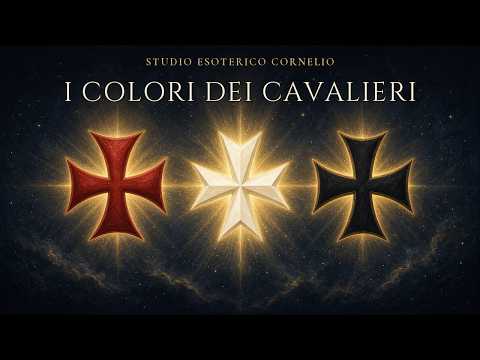
The brothers' habit was black, with an eight-pointed white cross on the breast. In battle the knights wore a red surcoat with a white cross, while the Templars had the white mantle with the red cross: two rival orders that could be told apart at a glance on the battlefields of the Holy Land.
Rhodes and the Temple's property
After the fall of Acre in 1291 the Hospitallers moved to Cyprus and in 1310 conquered the island of Rhodes, which they governed as a state for more than two centuries, with a fleet that opposed Turkish expansion. When the pope suppressed the Templars in 1312, the bull Ad providam assigned most of their property to the Hospitallers. In 1522 Suleiman the Magnificent besieged Rhodes; after six months the knights were allowed to leave the island with the honours of war.
Malta
In 1530 Emperor Charles V granted them Malta, in exchange for the symbolic annual tribute of a falcon. From then on they were the Knights of Malta. In 1565 they withstood the Great Siege by the Ottoman army, one of the most famous battles of the sixteenth century, and built Valletta, the fortified city named after Grand Master Jean de la Valette. Their rule ended in 1798, when Napoleon occupied the island.
Today
The Order still exists, with its seat in Rome, and is recognised as a subject of international law: the Sovereign Military Order of Malta, engaged in hospital and humanitarian work around the world. It is the only one of the great religious-military orders to have survived almost without interruption from the Jerusalem of the crusades, unlike the Templars of the fall of 1312. For their symbols, see the Templar cross and the symbols of the Order.
Watch the video
Sources and further reading
- J. Riley-Smith, The Knights Hospitaller in the Levant, c. 1070-1309 (2012)
- H. J. A. Sire, The Knights of Malta (1994)
- Paschal II, bull Pie postulatio voluntatis (1113)
- Clement V, bull Ad providam (1312)
- F. Balbi di Correggio, chronicle of the Great Siege of Malta (1567)
Read next
The Teutonic Knights
A field hospital beneath the walls of Acre became the German order that conquered Prussia: a black cross on a white mantle, the fortress of Marienburg and the defeat at Grunwald.
The Holy Grail: birth of a legend
From a mysterious “grail” in a twelfth-century French romance to the cup of the Last Supper: how the most sought-after object in European literature was born and transformed.
Perceval and Parzival: the knight of the question
The naive boy raised in the forest, the Grail castle and a silence that costs dearly: Perceval's story from Chrétien to Wolfram and on to Wagner's Parsifal, inspired by a garden in Ravello.
