Places and symbols
The Templar cross and the symbols of the Order
The red cross on the white mantle, the black-and-white banner, the seal with two knights on one horse, the round churches: the real symbols of the Templars and those invented later.
A red cross on a white mantle is enough for anyone to think of the Templars. It is the Order's most recognisable image, and yet its history, like that of the other Templar symbols, is more complex than is often believed.
The red cross
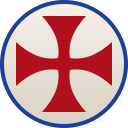
According to tradition, the right to wear the red cross on the mantle was granted to the Templars by Pope Eugene III in 1147, when the Order met in Paris on the eve of the Second Crusade. Red evoked the blood of martyrdom, white the purity of religious life. The shape of the cross was not fixed: medieval images show plain crosses, crosses whose arms widen at the ends, crosses of various proportions. The cross pattée, with flared arms, has become “the” Templar cross above all in the modern imagination.
The Baucent
In battle the Templars followed a banner divided into two fields, white and black, called the Baucent. In Old French the name meant a piebald horse. The Rule required the banner always to be protected: while it flew, no brother could leave the field. The white and black have been read as light and shadow, or as gentleness towards friends and harshness towards enemies, but these are later interpretations.
Two knights on one horse
The most famous seal of the Masters of the Temple shows two armed knights riding the same horse. For centuries it was interpreted as an image of the original poverty, when the first brothers did not have enough mounts; others see in it the symbol of brotherhood in arms or of the Order's double nature, monastic and military. On the reverse of some seals there is a domed building representing the Temple of Jerusalem, the Order's original seat.
The round churches
The Templars built some churches with a circular plan, inspired by the rotunda of the Holy Sepulchre in Jerusalem: the Temple Church in London, consecrated in 1185, is the most famous example, together with the rotunda of the convent of Tomar in Portugal. Not all round churches are Templar, and not all Templar churches are round, but this form remained linked to the memory of the Order.
Images from Italy
In Perugia, in the church of San Bevignate, thirteenth-century frescoes survive with knights in crossed mantles, battle scenes and figures of brothers: one of the richest visual records of the Templar presence in Europe. In Lazio, Tuscany and Apulia crosses and graffiti carved in stone are often attributed to the Templars; in many cases, however, the attribution is uncertain.
Invented symbols
Many symbols now associated with the Templars were born after their end. Baphomet, the idol the brothers supposedly worshipped according to their accusers, is a name that appears in the trial records, probably a corruption of “Mahomet”. The familiar image of the winged goat-like demon with a torch between its horns was drawn in 1856 by the French occultist Éliphas Lévi, five and a half centuries after the trial. In the same way, the links between the Templars and Masonic symbolism were constructed in the eighteenth century.
The power of the sign
What remains, then? A simple and very powerful sign: a cross over the heart, worn by men who had chosen to live between prayer and battle. It is this sign, more than any secret, that has crossed the centuries to reach us.
Watch the video
Sources and further reading
- French Rule of the Temple
- Seals of the Masters of the Temple (12th-13th century)
- Frescoes in the church of San Bevignate, Perugia
- É. Lévi, Dogme et rituel de la haute magie (1856)
- M. Barber, The New Knighthood (1994)
Read next
The sword in the stone of San Galgano
A Tuscan knight who in 1180 thrust his sword into the rock to make a cross, a rotunda on the hill of Montesiepi and a roofless abbey: the real sword in the stone is near Siena.
Glastonbury, the Isle of Avalon
An abbey in flames, Arthur's tomb found by the monks, the hill of the Tor and the red spring of Chalice Well: how a Somerset town became the Avalon of legend.
King Arthur in the Otranto mosaic
On the floor of Otranto cathedral, between the tree of life and Alexander the Great, a king riding a goat bears an unexpected name: "Rex Arturus". Arthurian traces in twelfth-century Italy.
