
Places and symbols
Glastonbury, the Isle of Avalon
An abbey in flames, Arthur's tomb found by the monks, the hill of the Tor and the red spring of Chalice Well: how a Somerset town became the Avalon of legend.

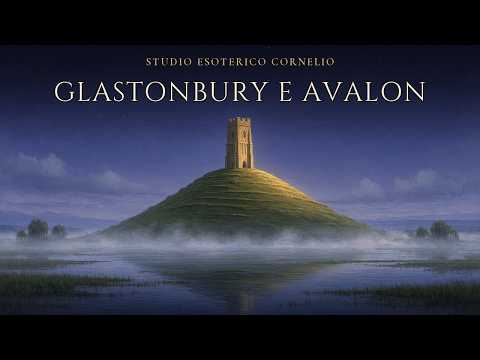
In Somerset, in south-west England, a conical hill rises above the flatlands of the Levels: Glastonbury Tor, crowned by the lonely tower of a vanished church. In the Middle Ages the plain was often flooded, and the hill looked like an island. At its foot stood one of the richest abbeys in the kingdom. Between the late twelfth and the fourteenth century the monks made this place King Arthur's Avalon and the first Christian ground in Britain.
The fire and the tomb
In 1184 a fire destroyed much of the abbey. A few years later, in 1191, the monks announced an extraordinary discovery: digging in the cemetery between two ancient stone pyramids they had found a deep burial, with a hollowed trunk holding the bones of a gigantic man and of a woman, whose golden hair supposedly crumbled at a touch. Above lay a lead cross with a Latin inscription: here lies buried the renowned King Arthur, in the Isle of Avalon. Gerald of Wales, who saw the remains, recorded the discovery a few years later.
A convenient discovery
Historians are sceptical. The abbey needed funds for rebuilding, and the tomb drew pilgrims; moreover it suited the king of England to show that Arthur was truly dead, against the Welsh hope of his return. In 1278 Edward I and Queen Eleanor attended the reburial of the bones before the high altar. The lead cross was lost in the eighteenth century; a drawing of it survives, published by William Camden.
Joseph of Arimathea and the Grail
In the thirteenth century the abbey's tradition gained an even more illustrious founder: Joseph of Arimathea, who had come with his companions to build the first church on the island. At the foot of the Tor the spring of Chalice Well, its water tinged red by iron, was associated with the blood of Christ and with the Grail vessel hidden nearby.
The end of the abbey
In 1539, during Henry VIII's dissolution of the monasteries, the last abbot, Richard Whiting, was condemned and executed on the summit of the Tor. The abbey was stripped and its stones reused; the ruins of the church and the abbot's kitchen can be visited today, and a sign marks the spot of Arthur's supposed tomb.
Modern Avalon
Since the twentieth century Glastonbury has become a centre of alternative spirituality, with ley lines, music festivals and neopagan communities. Beyond fashions, it remains a landscape in which the legends of Arthur, of the Holy Grail and of early British Christianity have settled in layers: a place to read alongside King Arthur under Etna, the other, Mediterranean Avalon.
Watch the video
Sources and further reading
- Gerald of Wales, De principis instructione (c. 1193)
- William of Malmesbury, De antiquitate Glastonie ecclesie
- John of Glastonbury, Cronica (14th c.)
- J. P. Carley, Glastonbury Abbey. The Holy House at the Head of the Moors Adventurous (1988)
- R. Gilchrist - C. Green, Glastonbury Abbey. Archaeological Excavations 1904-1979 (2015)
Read next
The sword in the stone of San Galgano
A Tuscan knight who in 1180 thrust his sword into the rock to make a cross, a rotunda on the hill of Montesiepi and a roofless abbey: the real sword in the stone is near Siena.
The Templar cross and the symbols of the Order
The red cross on the white mantle, the black-and-white banner, the seal with two knights on one horse, the round churches: the real symbols of the Templars and those invented later.
King Arthur in the Otranto mosaic
On the floor of Otranto cathedral, between the tree of life and Alexander the Great, a king riding a goat bears an unexpected name: "Rex Arturus". Arthurian traces in twelfth-century Italy.
