Places and symbols
Rosslyn Chapel
A fifteenth-century Scottish chapel covered in carvings, a pillar with a bloody legend and a century of theories about Templars, the Grail and Freemasonry: what the stone really says.
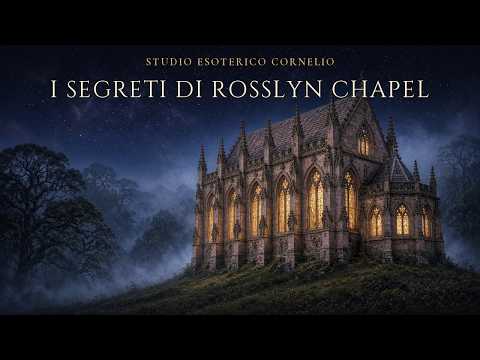
A few kilometres south of Edinburgh, in the village of Roslin, stands a small Gothic church that looks almost unfinished. It was founded in 1446 by Sir William Sinclair, Earl of Orkney, as a collegiate church dedicated to St Matthew. It was meant to be a much larger cruciform building, but when the founder died, in 1484, only the choir had been built. This is the part we now call Rosslyn Chapel.
A church of carved stone
The interior is covered with carvings as few medieval buildings are: musician angels, vices and virtues, biblical scenes, a dance of death, leaves and flowers. More than a hundred "green men" can be counted, human faces from which branches and foliage sprout. On a lintel is carved the only original inscription, taken from the Book of Esdras: wine is strong, the king is stronger, women are stronger still, but above all things truth prevails.
The Apprentice Pillar
The most famous column is wrapped in spiralling bands of foliage. The legend, recorded in the eighteenth century, tells that the master mason left to study the model of a pillar and that, meanwhile, his apprentice carved a finer one; on his return the master, blinded by envy, killed him with a blow of his mallet. Similar stories are told in many European cathedrals, but here the legend has found its stage.
Templars, the Grail and the Freemasons
Since the twentieth century Rosslyn has become the centre of countless theories. The Templars supposedly took refuge here after the fall of the Order, the Grail is supposedly hidden here, or the head of Christ, or the scrolls of the Temple of Jerusalem. The novel The Da Vinci Code (2003) and the film based on it brought hundreds of thousands of visitors to Roslin. Historians point out that the Order of the Temple had been suppressed more than a century before the foundation, and that the carvings contain nothing that requires a Templar secret.
The real link with Freemasonry
A historical link does exist with the masons. In the seventeenth century the Sinclairs of Roslin were recognised in certain documents as hereditary patrons of the Scottish masons, and in 1736 a William St Clair was the first Grand Master of the Grand Lodge of Scotland. Scotland is one of the cradles of modern Freemasonry, and Rosslyn has become one of its icons, more as a symbol than as evidence.
What to look at
The "ears of maize" carved on an arch, which some read as proof of voyages to America before Columbus, are for most scholars stylised flowers or wheat. It is more rewarding to look at the chapel for what it is: a rare jewel of Scottish Gothic, saved from centuries of neglect and carefully restored. For the Templars' symbols, the authentic ones, one can start from the cross of the Order.
Watch the video
Sources and further reading
- Earl of Rosslyn, Rosslyn Chapel (Rosslyn Chapel Trust, 1997)
- C. McWilliam, The Buildings of Scotland: Lothian except Edinburgh (1978)
- D. Stevenson, The Origins of Freemasonry. Scotland's Century 1590-1710 (1988)
- M. Baigent - R. Leigh, The Temple and the Lodge (1989)
Read next
The sword in the stone of San Galgano
A Tuscan knight who in 1180 thrust his sword into the rock to make a cross, a rotunda on the hill of Montesiepi and a roofless abbey: the real sword in the stone is near Siena.
The Templar cross and the symbols of the Order
The red cross on the white mantle, the black-and-white banner, the seal with two knights on one horse, the round churches: the real symbols of the Templars and those invented later.
Glastonbury, the Isle of Avalon
An abbey in flames, Arthur's tomb found by the monks, the hill of the Tor and the red spring of Chalice Well: how a Somerset town became the Avalon of legend.
